


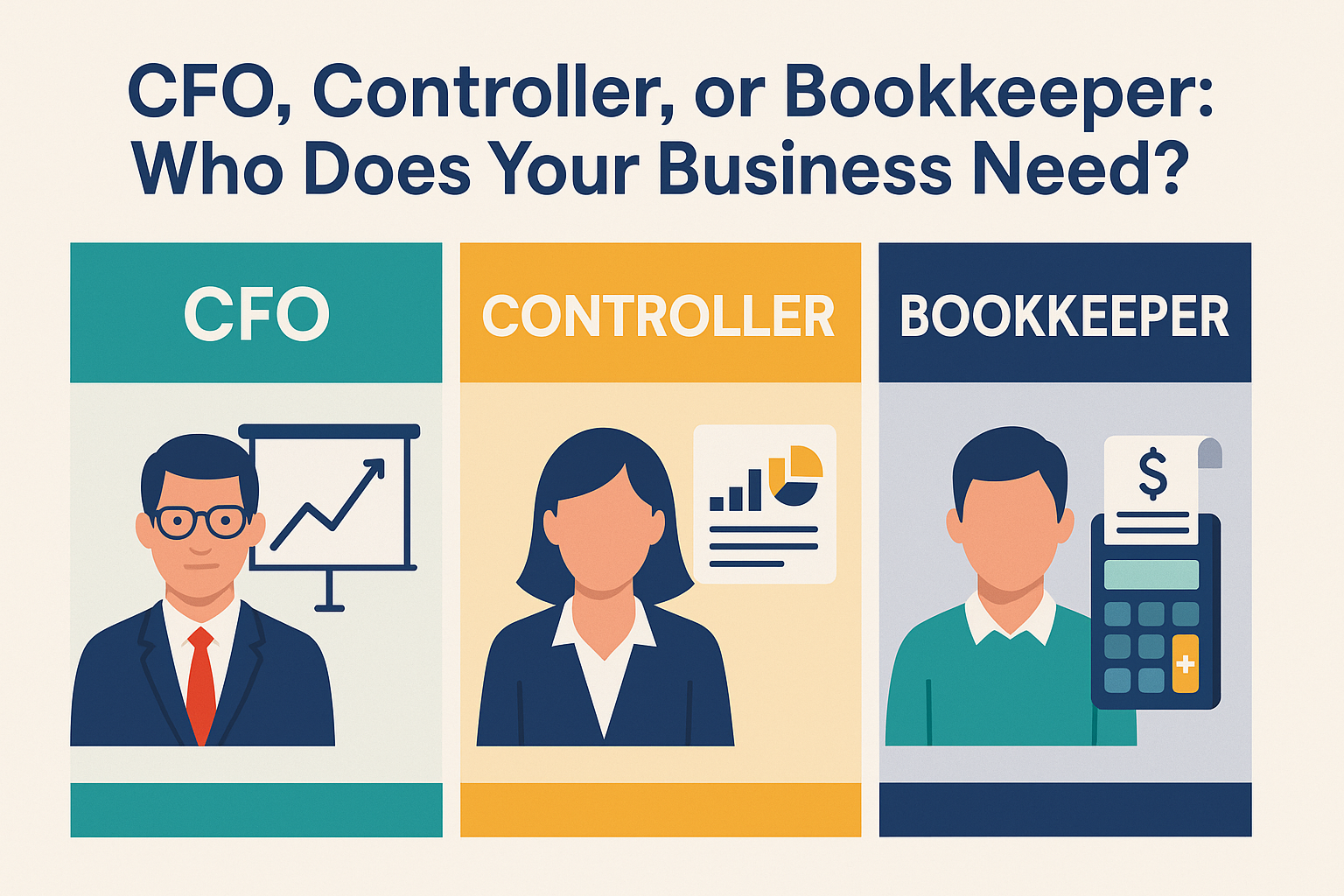
CFO, Controller, or Bookkeeper: Who Does Your Business Need?
🔍 Introduction
For many business owners, the world of finance roles can be puzzling. Do you just need a bookkeeper to manage your books? At what point do you need a controller? And what exactly would a CFO do that’s different?
Think of these roles as layers of your financial infrastructure:
Bookkeepers lay the foundation, controllers build structured systems, and CFOs add the strategic roof. In this guide, we’ll break down each role’s responsibilities, when you need them, and how they impact your growth.
📒 The Bookkeeper: Recording the Transactions
- What They Do: Bookkeepers handle daily tasks like recording income, managing invoices, processing payroll, and reconciling bank statements. They keep your general ledger up to date.
- Focus: Historical and transactional. Bookkeepers document what has already happened.
- Skills: Detail-oriented, proficient with accounting tools, and trained in categorization and reconciliation. Not necessarily CPAs, but often certified professionals.
- Pain Points Solved: They fix messy books, eliminate backlog, and give you clear visibility into profits and cash flow. They also free up your time.
- When to Hire: From day one, or as soon as your transaction volume grows. Outsourced services work well for startups and solopreneurs.
📊 The Controller: Managing the Financial Operations
- What They Do: Controllers oversee bookkeepers, run the month-end close, create reliable financial reports, enforce policies, and ensure compliance. They introduce internal controls and budgeting practices.
- Focus: Internal operations and near-term planning. Controllers validate and interpret past data while forecasting short-term financial needs.
- Skills: CPA or equivalent, accounting leadership, policy enforcement, data analysis. Often the first finance “manager” in a growing business.
- Pain Points Solved: When you can’t trust your numbers, have compliance concerns, or experience cash crunch surprises, a controller brings control and clarity.
- When to Hire: Around $1M–$5M in annual revenue or when financial complexity increases. Fractional controllers can support early growth efficiently.
🚀 The CFO: Strategic Financial Leadership
- What They Do: CFOs are forward-looking strategists. They drive financial planning, investor relations, fundraising, M&A, and long-term value creation. They oversee the controller and bookkeeper.
- Focus: Strategy, financial forecasting, capital planning, and big-picture decision-making.
- Skills: Deep financial acumen, leadership, fundraising, and executive-level communication. Often former controllers or VPs of Finance.
- Pain Points Solved: If you’re making strategic moves (expansion, investment, pricing changes) and need financial strategy or board-level insight, a CFO is vital.
- When to Hire: Usually post-Series A, $10M+ revenue, or major complexity. Fractional CFOs offer strategic firepower without the full-time price tag.
🔄 How They Work Together Across Business Stages
Here’s a quick breakdown of how these roles evolve as your business grows:
- Startup: Part-time bookkeeper + fractional CFO (for key decisions)
- Growth: Full-time bookkeeper + part-time controller (for reporting, controls)
- Scale: Full bookkeeping team + controller + fractional or full-time CFO
- Mature: Layered finance org with CFO, controller, and bookkeeping ops
💡 Example: If you’re noticing cash is tight… your bookkeeper alerts you, the controller forecasts the shortfall, and the CFO secures a loan or adjusts spending.
🧭 Choosing the Right Role for Your Needs
Use this simple filter:
- 📘 Need clean records? → Hire a bookkeeper
- 📊 Need accurate reporting and internal controls? → Bring in a controller
- 🚀 Need strategy, capital, or financial transformation? → Engage a CFO
Budget tip: Bookkeepers are most affordable. Controllers cost more, and CFOs are the highest. But you can always start with fractional roles until full-time makes sense.
✅ Conclusion: Align Your Financial Talent with Growth
Every successful business eventually needs all three roles: a bookkeeper to organize the data, a controller to turn it into insight, and a CFO to turn it into strategy.
Whether you’re just starting out or scaling fast, the key is knowing when to level up. By hiring or outsourcing the right role at the right time, you’re building a foundation for long-term success.
📌 Pro Tip: Don’t wait until things break. Plan your finance team like you plan your product roadmap — with growth in mind.